

Resilience is often described as strength under stress.
Architecturally, it is structure under variability.
In the previous article established that resilience is designed before it is tested. That design does not live in inventory levels or software configuration. It lives in how variability, capital, authority, and lifecycle discipline are aligned before disruption occurs.
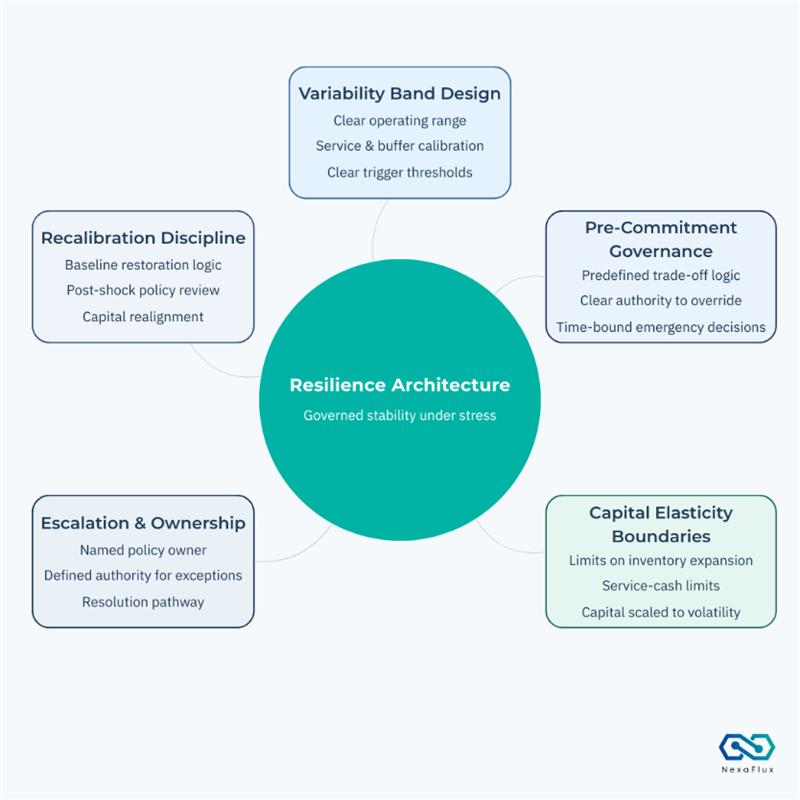
Resilience architecture is not a single policy. It is a connected system. When its elements are aligned, stability feels deliberate. When they are not, volatility exposes the gaps.
Variability Band Design
All resilience begins with explicit recognition of variability.
Demand fluctuates.
Lead times shift.
Supplier performance moves.
The issue is not whether variability exists. It always does. The issue is whether the organization has defined the range it intends to design for.
Variability band design establishes the operating envelope of the system. Service targets, buffer logic, and planning assumptions are calibrated within that envelope.
Consider a replenishment policy built around five days of lead-time fluctuation. If actual variation regularly stretches to fifteen days, teams will feel pressure long before anyone labels it a design problem. Expedites increase. Buffers creep upward. Meetings multiply. The system appears unstable, even if planning discipline remains strong.
The instability is not behavioral. It is architectural.
When volatility remains inside the defined band, the system absorbs it quietly. When volatility exceeds the band, structural response activates.
Without explicit band definition, response becomes subjective. With it, response becomes consistent.
Pre-Commitment Governance
If variability design defines the envelope, pre-commitment governance defines the response.
Shocks force trade-offs. Protect service or protect cash. Expedite supply or protect margin. Reallocate inventory or preserve allocation logic.
In resilient systems, these trade-offs are not invented during disruption. They are defined in advance.
Pre-commitment governance clarifies:
- The conditions under which buffers may expand
- The authority required to authorize override
- The time horizon of emergency decisions
This creates predictability when pressure rises. Instead of searching for alignment, the organization activates logic that has already been agreed upon.
Pre-commitment does not eliminate tension. It ensures tension is resolved through structure rather than improvisation.
Capital Elasticity Boundaries
Resilience decisions change capital exposure.
When volatility rises, inventory often rises with it. Expedites increase cost. Supplier diversification shifts working capital velocity. These are rational responses. They are also financial decisions.
Capital elasticity boundaries define how far the organization is willing to stretch under stress.
They clarify:
- The acceptable range of inventory expansion
- The financial tolerance for service protection
- The relationship between volatility intensity and capital deployment
Without these boundaries, buffers tend to expand gradually and remain elevated because no structural limit exists.
With explicit capital guardrails, resilience actions remain financially coherent. The organization absorbs volatility without drifting away from its economic model.
Capital discipline does not weaken resilience. It anchors it.
Escalation and Ownership Architecture
Authority clarity determines whether resilience functions smoothly under pressure.
When variability exceeds defined bands, escalation pathways must activate without ambiguity. Ownership must already be clear.
Escalation architecture defines:
- Accountability for resilience policy integrity
- Authority for approving exceptions
- The pathway through which cross-functional tension is resolved
In the absence of predefined authority, volatility often migrates into meetings. Decisions slow. Operational strain spreads. What begins as variability becomes organizational friction.
Resilience architecture does not remove pressure. It channels pressure through defined ownership.
Recalibration Discipline
Resilience architecture includes a lifecycle.
Emergency buffers, cadence adjustments, and sourcing shifts are responses to abnormal conditions. When volatility stabilizes, the system must either restore its baseline or consciously adopt a new one.
Recalibration discipline ensures:
- Temporary measures do not become permanent defaults
- Policy adjustments are reviewed against post-shock conditions
- Capital exposure realigns with intended operating assumptions
Many organizations respond decisively to disruption. Fewer unwind with equal discipline. Over time, accumulated emergency decisions reshape the system quietly.
Without recalibration, resilience responses leave structural residue. Complexity increases. Baselines drift.
With recalibration, resilience remains intentional.
Interdependence of the Five Dimensions
These dimensions operate together.
- Variability band design determines when structural response activates.
- Pre-commitment governance defines how that response unfolds.
- Capital elasticity boundaries constrain its financial scale.
- Escalation architecture clarifies who executes it.
- Recalibration discipline restores equilibrium afterward.
If one dimension weakens, pressure migrates toward it. Undefined variability increases escalation frequency. Unbounded capital stretches balance sheets. Ambiguous ownership slows resolution. Missing recalibration turns temporary response into permanent complexity.
Resilience maturity is therefore systemic. It emerges from alignment across design, authority, finance, and lifecycle governance.
The five dimensions are not sequential controls. They form a connected architecture.
Architectural States
Organizations evolve through structural states.
In earlier states, variability is absorbed through effort. Authority clarifies during tension. Capital expands reactively. Recalibration is inconsistent.
In integrated states, variability envelopes are explicit. Trade-offs are predefined. Capital boundaries are clear. Ownership is named. Reset logic is deliberate.
The difference is structural coherence.
Resilience architecture becomes visible not only in crisis response, but in the quiet clarity that exists before crisis occurs.
Closing Thoughts
Resilience is often described in emotional terms such as strength or agility.
Architecturally, it is more disciplined.
- It is defined variability bands.
- Pre-committed response logic.
- Explicit capital guardrails.
- Clear authority.
- Deliberate recalibration.
When these elements align, resilience is not reactive capacity. It is governed stability under stress.
That architecture exists before it is needed.