

Resilience is often discussed during disruption.
It is rarely designed before disruption.
When supply chains fracture, the language shifts quickly to recovery plans, risk teams, redundancy, and buffers. But by the time disruption arrives, resilience has already been determined.
Resilience is not built during stress.
It is revealed.
And what it reveals is governance design.
In practice, that means whether S&OP authority is predefined, whether service bands are fixed before volatility rises, and whether escalation paths are documented before a disruption forces improvisation.
Resilience Is Not Inventory
In many organizations, resilience is confused with stock levels.
- If inventory is high, the system is assumed to be resilient.
- If redundancy exists, leadership feels protected.
- If alternative suppliers are approved, the risk box appears checked.
These tools matter. But they do not create resilience.
- Buffers can absorb shocks only if the decision system governing them is coherent.
- Redundancy works only if escalation paths are clear.
- Supplier alternatives matter only if authority is defined when trade-offs must shift.
Resilience is not the presence of protection. It is the structure that governs how protection is deployed.
Buffer architecture contributes to resilience and reliability, but it does not precede them. Governance design determines how buffers function under stress.
Governance Design Determines Response Speed
Imagine a disruption occurs tomorrow.
A supplier fails.
A major customer demand spike emerges.
A geopolitical event restricts capacity.
The immediate question is not: Do we have enough inventory?
The immediate question is: Who decides, under what authority, and within what thresholds?
Response speed depends on four invisible design choices:
- Clarity of decision rights
- Defined variability bands
- Escalation pathways
- Override discipline
If these are ambiguous, disruption amplifies instability. If these are disciplined, the system absorbs pressure without fragmentation.
Resilience reflects those prior design decisions. 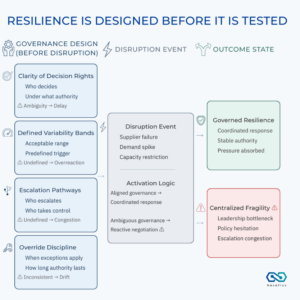
A Practical Illustration: Governance in Action1
A frequently cited example comes from Texas-based grocery chain H-E-B. According to industry reporting, H-E-B activates its emergency operations structure approximately one week before a forecasted disruption, operating under a predefined command model rather than improvising once a crisis begins. Decision cadence accelerates early. Allocation logic is clarified. Cross-functional coordination is formalized before the storm makes landfall. During the July 2025 Central Texas floods, H-E-B deployed mobile kitchens, disaster relief supply units, and committed more than $5 million to recovery efforts while maintaining operational continuity. The key variable was not inventory. It was pre-committed governance.- The command structure existed before the disruption.
- Authority thresholds were defined before volatility rose.
- Decision rhythm was established before uncertainty intensified.
The Illusion of Reactive Resilience
Organizations often believe they “became resilient” after surviving a crisis. What actually happened is different. They improvised. Improvisation is not resilience. Improvisation is leadership compensation for weak governance.
True resilience does not depend on heroic intervention.
It depends on structured authority and pre-commitment.
When resilience depends on senior leaders personally coordinating cross-functional decisions under stress, the system is fragile. It only appears strong because leadership capacity temporarily masks structural weakness.
That model does not scale.
Where Governance Fails Under Stress
Resilience breaks when governance design has three weaknesses:-
- Trade-off Ambiguity
- Policy Fragility
- They wait for approval.
- They escalate prematurely.
- They override inconsistently.
- Escalation Congestion
If cost, service, and utilization priorities are not clearly structured before disruption, they must be negotiated during disruption. That negotiation slows response.
If policies are aspirational rather than operational, teams hesitate.
Speed declines not because people lack urgency, but because authority is unclear.
When thresholds are undefined, every shock becomes a leadership event. Senior leaders become routing centers instead of strategic actors. That is not resilience. That is centralized fragility.
Resilience Is a Byproduct of Structural Discipline
When governance is disciplined:
- Trade-offs are explicit
- Policies are pre-committed
- Escalation logic is clear
- Variability bands are defined
Under these conditions, disruption tests the system but does not fracture it.
When governance is undisciplined:
- Trade-offs are deferred
- Policies are informal
- Authority is ambiguous
- Escalation is political
Under these conditions, disruption exposes instability that already existed.
Resilience does not appear at the moment of crisis. It reflects structural decisions made long before.
The Quiet Test
If disruption occurred tomorrow:
- Who would decide first?
- Within what predefined band?
- Under which policy?
- With what authority to override?
If those answers are unclear, resilience is aspirational.
If those answers are predefined, resilience is structural.
Resilience reflects governance design. And governance design reflects leadership discipline long before disruption tests it.