

Optimization is attractive because it promises relief.
Reduce inventory. Improve service. Increase utilization. Shorten lead times. Lower cost.
The language suggests tension can be removed.
It cannot.
All optimization shifts pressure elsewhere in the system. Trade-offs do not disappear. They relocate.
Mature supply chains do not attempt to eliminate trade-offs. They make them explicit.
Why Optimization Feels Like Resolution
Operational metrics are siloed by design.
- Inventory can decline on the dashboard while expediting quietly increases behind the scenes.
- Utilization can improve while recovery headroom narrows.
- Service levels can rise while working capital expands.
- Lead times can compress while cost variability grows.
Each metric improves in isolation. The system absorbs the counter-pressure somewhere less visible.
This is not mismanagement. It is structural physics.
The only question is whether leadership anticipates where the pressure will move.
How Trade-Offs Shift in Practice
Consider inventory reduction.
Cash flow improves. Balance sheets strengthen. Two months later, supplier strain increases and expediting becomes routine. The trade-off shifted from capital intensity to execution volatility.
Consider high utilization.
Efficiency metrics look strong. Then demand variability rises. Lead times stretch. Customer confidence erodes. The trade-off shifted from idle capacity to responsiveness.
Or consider aggressive service targets.
Customer satisfaction improves. Capital requirements expand. Margin tightens. The trade-off shifted from revenue risk to financial pressure.
This dynamic is not theoretical.
In 2025, the International Air Transport Association estimated that persistent aerospace supply chain bottlenecks could cost global airlines more than 11 billion dollars in additional expenses. Carriers have operated older aircraft longer, leased engines, and increased spare parts inventories to protect service continuity. The effort to preserve reliability did not eliminate cost pressure. It relocated it into higher capital intensity and operating expense.
The same pattern appears in retail. Stockouts in the U.S. retail food sector are estimated to cost between 15 and 20 billion dollars annually in lost sales. Efforts to minimize inventory improve working capital metrics but can shift pressure directly into revenue and customer satisfaction when variability is not absorbed elsewhere.
In each case, optimization did not fail. It moved pressure.
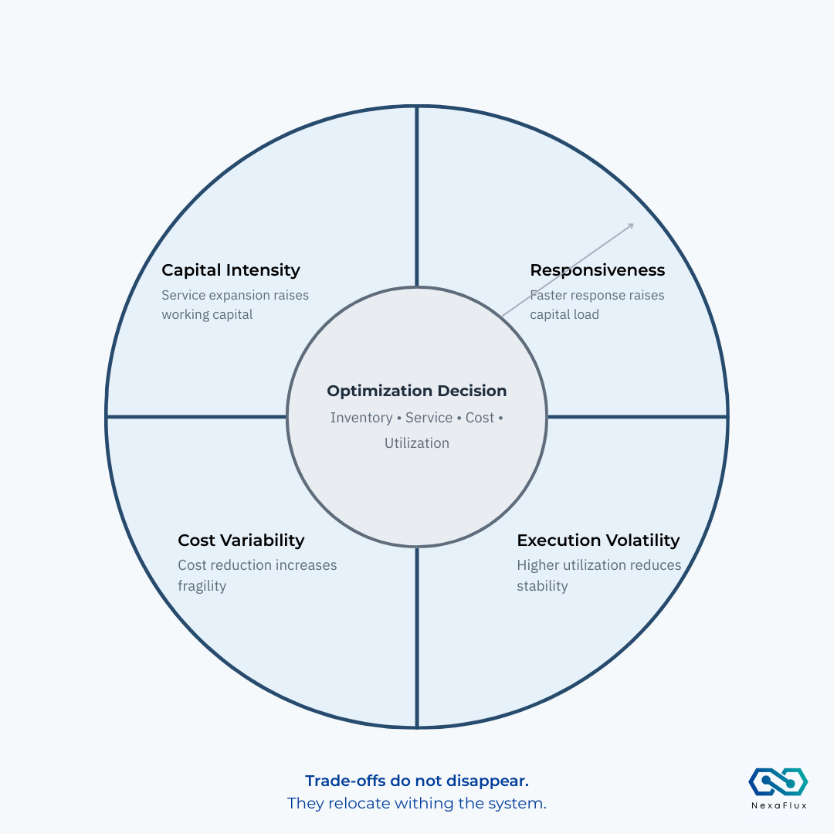
The diagram captures this relocation dynamic. Optimization decisions originate at the center, but the pressure they create redistributes across capital intensity, responsiveness, execution stability, and cost variability. Strengthening one dimension without anticipating the counter-pressure simply shifts strain elsewhere inside the system.
Trade-off literacy means identifying the new pressure location before it destabilizes performance.
Trade-Off Literacy as Maturity
In immature systems, trade-offs are debated emotionally. Operations defends service. Finance defends cash. Procurement defends cost. The exchange itself remains unnamed. No one names the exchange explicitly. Consequences surface later as instability.
In mature systems, leaders articulate the exchange before acting.
- We are reducing inventory and increasing dependence on supplier reliability.
- We are improving utilization and reducing recovery headroom.
- We are increasing service and expanding capital intensity.
Naming the exchange stabilizes the system.
When trade-offs are explicit, downstream effects are expected rather than surprising.
Governance Implication
Trade-offs influence policy.
If leaders do not clearly state the trade-off being made, policies often attempt to optimize opposing goals at the same time. The tension does not disappear. It relocates into buffers, expediting, capital creep, or service instability.
For example, a policy demanding 98% service while reducing inventory forces the system to absorb the conflict through expediting or working capital expansion.
The issue is not the trade-off itself. The issue is whether the organization has consciously chosen which pressure to carry.
Before optimizing any dimension, leadership should ask:
- What are we improving?
- What are we accepting in return?
If the second question has no clear answer, the decision is incomplete.
A Sharper Quiet Test
At your next improvement initiative, ask:
If this succeeds, what new strain will appear?
If no one can name it, the trade-off has been displaced, not managed.
Stability does not come from removing tension. It comes from distributing tension deliberately.