

Why Timing Discipline Shapes Supply Chain Stability
Most supply chain discussions focus on what decisions are made.
Fewer examine when those decisions occur.
Yet timing discipline influences execution stability as much as policy clarity or buffer design.
In prior principles, we established that governance and architecture shape performance. Here we focus on rhythm.
When decisions lack consistent timing, the system oscillates. Irregular review cycles and reactive overrides amplify variability that would otherwise remain contained.
Structured cadence does not eliminate uncertainty. It stabilizes uncertainty by aligning commitments to predictable intervals.
Stability is rarely a forecasting problem.
It is often a timing problem.
This article explains why cadence matters and how it reveals itself in observable organizational behavior.
Oscillation Is a Timing Symptom
Every supply chain experiences fluctuations in demand, supply, and lead times.
What differentiates stable systems from unstable ones is not the presence of variability. It is how timing discipline absorbs or amplifies that variability.
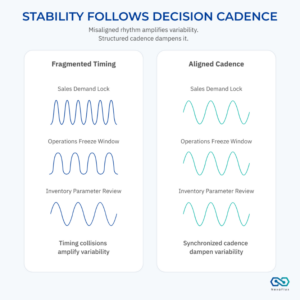
When decisions are made at irregular intervals, commitments misalign.
- Sales may adjust forecasts weekly.
- Operations may freeze plans monthly.
- Finance may reconcile forecasts quarterly.
Each function is disciplined within its own rhythm. Collectively, the rhythms collide.
- Forecast revisions arrive after production freeze windows close.
- Inventory builds just after demand is revised downward.
- Corrective actions occur before prior commitments have played out.
The system overcorrects.
This is not primarily a forecasting failure. It is a cadence failure.
What Cadence Actually Does
Cadence is not meeting frequency. It is predefined decision timing aligned to operational flow.
Effective cadence clarifies:
- When demand signals are locked
- When supply commitments are revised
- When inventory parameters are reconsidered
- When exceptions are reviewed
- When leadership evaluates aggregated risk
Without cadence:
- Decisions occur continuously and reactively.
- Overrides accumulate mid-cycle.
- Planning becomes a running negotiation.
With cadence:
- Adjustments occur at predictable intervals.
- Cross-functional tension surfaces at structured checkpoints.
- Short-term noise is filtered before triggering structural change.
Timing does not remove uncertainty. It contains it.
Industry practitioners consistently observe that frequent ad hoc forecast revisions increase noise chasing and destabilize execution. Structured update intervals reduce reactive adjustments and improve planning reliability.1
Similarly, leading consumer goods and manufacturing firms are synchronizing shorter operational review cycles with formal planning cadence to improve responsiveness without amplifying variability.2
These examples reinforce a structural insight: When decision intervals are predictable and aligned, execution stabilizes.
The Hidden Cost of Irregular Timing
When review cycles drift:
- Forecasts are reopened mid-period
- Production sequencing changes after freeze windows
- Inventory parameters adjust outside policy checkpoints
The result is not agility. It is amplified variability.
In many mid-sized manufacturers, inventory peaks just after a late-cycle forecast revision, then collapses when production catches up. The pattern repeats quarterly. Demand did not swing that violently. Timing did.
Irregular cadence produces operational whiplash.
Cadence as Structural Dampener
Organizations often believe they “became resilient” after surviving a crisis. What actually happened is different. They improvised. Improvisation is not resilience. Improvisation is leadership compensation for weak governance.
True resilience does not depend on heroic intervention.
It depends on structured authority and pre-commitment.
When resilience depends on senior leaders personally coordinating cross-functional decisions under stress, the system is fragile. It only appears strong because leadership capacity temporarily masks structural weakness.
That model does not scale.
Where Governance Fails Under Stress
Stable systems share one structural characteristic. Decision intervals are synchronized with operational flow.
Demand reviews align with production freeze windows. Inventory recalibration aligns with variability assessment cycles.
Executive overrides occur within declared escalation windows.
When timing is synchronized:
- Corrections dampen instead of amplify
- Teams anticipate adjustment windows
- Cross-functional alignment strengthens
- Exceptions decline because structure absorbs noise
Stability is not the absence of movement. It is disciplined rhythm. Cadence is governance expressed through time.
The Cadence Test
Consider your system:
- Which decisions are made continuously rather than cyclically?
- Which overrides occur outside declared review intervals?
- Do planning cycles align across functions or drift independently?
- When volatility rises, does decision timing tighten or fragment?
If critical decisions lack defined cadence, instability will surface elsewhere.
Stability follows decision cadence.
Without timing discipline, policy and architecture cannot fully function.
Closing Reflection
Forecast accuracy matters. But even accurate forecasts destabilize systems when decision timing is inconsistent. Execution stability is not only a structural question of buffers and governance. It is also a question of rhythm.
Organizations that treat cadence as architecture dampen variability before it spreads. Those that treat timing as flexible amplify it. Stability is not declared.
It is scheduled.