

Policy as Pre-Commitment: The Governance Discipline Behind Decision Quality

Policy as Pre-Commitment The Governance Discipline Behind Decision Quality

Every organization makes decisions. Few institutionalize them. 

Trade-offs are debated. Targets are set. Alignment is declared. Yet when pressure rises, those same decisions are revisited. 

The organization does not say it is renegotiating strategy. 

It says: 

  • “This situation is different.” 
  • “We need an exception.” 
  • “Let’s review this case.” 

Over time, the volume of exceptions increases. Escalations multiply. Senior leaders spend more time resolving recurring tensions that were supposedly settled. 

The issue is not capability. It is the absence of pre-commitment.  

Repeated executive debate on previously settled issues is not engagement. It is governance drift. 

Policy is how leadership decides once so that it does not have to decide repeatedly under stress. 

Why Trade-Offs Alone Are Not Enough 

In the trade-off series, we established that trade-offs do not disappear. They shift. 

But naming a trade-off is only the first step. If that trade-off is not embedded into policy, it becomes fragile. 

Consider three common executive scenarios: 

  • A company declares capital discipline yet planning parameters do not specify acceptable inventory variability bands. Working capital debates reappear monthly. 
  • A firm announces service as the priority, yet escalation thresholds are undefined. Customer exceptions multiply and leadership must personally intervene. 
  • A manufacturer pushes utilization higher without formally protecting recovery capacity. When variability increases, responsiveness erodes and “temporary” workarounds become permanent. 

In each case, the trade-off was discussed. It was not institutionalized. That gap creates volatility. 

What Policy Actually Does 

Policy is not bureaucracy. Policy is leadership saying: Under these conditions, we will respond this way. 

It converts a strategic choice into a repeatable rule. Effective policy defines: 

  • Acceptable variability bands 
  • Decision thresholds 
  • Escalation triggers 
  • Approval rights 
  • Override conditions 

Without this structure, execution teams must improvise. Improvisation increases cost, slows response, and creates inconsistent outcomes across the organization. 
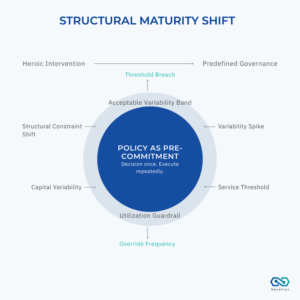
Policy reduces the need for heroic leadership intervention. If planners override parameters every month without structured escalation, the policy is undefined. If overrides require threshold justification and documented review, the policy exists. 

The Performance Case for Pre-Commitment 

Research supports the performance impact of disciplined decision systems. 

Bain & Company has found that organizations with strong decision effectiveness, including clarity of decision rights and governance structure, materially outperform peers on financial and operational metrics. Firms that excel at decision effectiveness demonstrate stronger growth and execution consistency relative to competitors.  

Similarly, McKinsey & Company emphasizes that organizations designed to make faster and better decisions outperform peers on growth and profitability. Much of this advantage stems from clearer decision rights and reduced ambiguity in governance, not from superior data alone. 

The differentiator is not intelligence. It is disciplined pre-commitment. 

Pre-Commitment Reduces Leadership Fatigue 

In unstable environments, the volume of executive decisions increases. 

Without policy: 

  • Leaders become bottlenecks. 
  • Exceptions escalate upwards. 
  • Teams hesitate, waiting approval. 
  • Confidence declines because outcomes appear inconsistent. 

With policy: 

  • Most decisions are resolved within predefined boundaries. 
  • Escalations occur only when thresholds are breached. 
  • Leadership attention is reserved for genuinely strategic issues. 

Pre-commitment does not remove flexibility. It preserves executive judgment for situations that truly require it. 

Policy as Maturity Marker 

Immature systems rely on heroic intervention. Mature systems rely on predefined rules. When volatility rises, the question shifts from: “What should we do now?” to “Does this fall within our predefined band, or does it trigger escalation?” 

That difference defines structural maturity. It reflects whether leadership has translated strategy into durable governance. 

Governance Implication 

If trade-offs define where pressure lives, policy determines whether that pressure is managed consistently. In practice, this becomes visible when the same exception reappears in weekly S&OP reviews because escalation boundaries were never formalized. 

Before declaring any strategic priority, leadership should ask: 

  • Have we defined the conditions under which this priority holds? 
  • Have we specified when escalation overrides it? 
  • Have we aligned decision rights and thresholds accordingly? 

If the answer is no, the organization will renegotiate the decision under stress. 

That is instability by design.  

Policy is not control. It is disciplined pre-commitment. And disciplined pre-commitment is what turns strategy into structure.